Srivatsa Ramaswami — 33 Years of Direct Study with Krishnamacharya
Why one student's three-decade apprenticeship with the father of modern yoga matters more than most yoga history you've heard.
If you've practised yoga for more than a year, you've heard Krishnamacharya's name. What's less known is the story of his longest-tenured student — Srivatsa Ramaswami — who studied under him for thirty-three years and now carries the most complete picture of his teachings.
A weekend workshop is not yoga
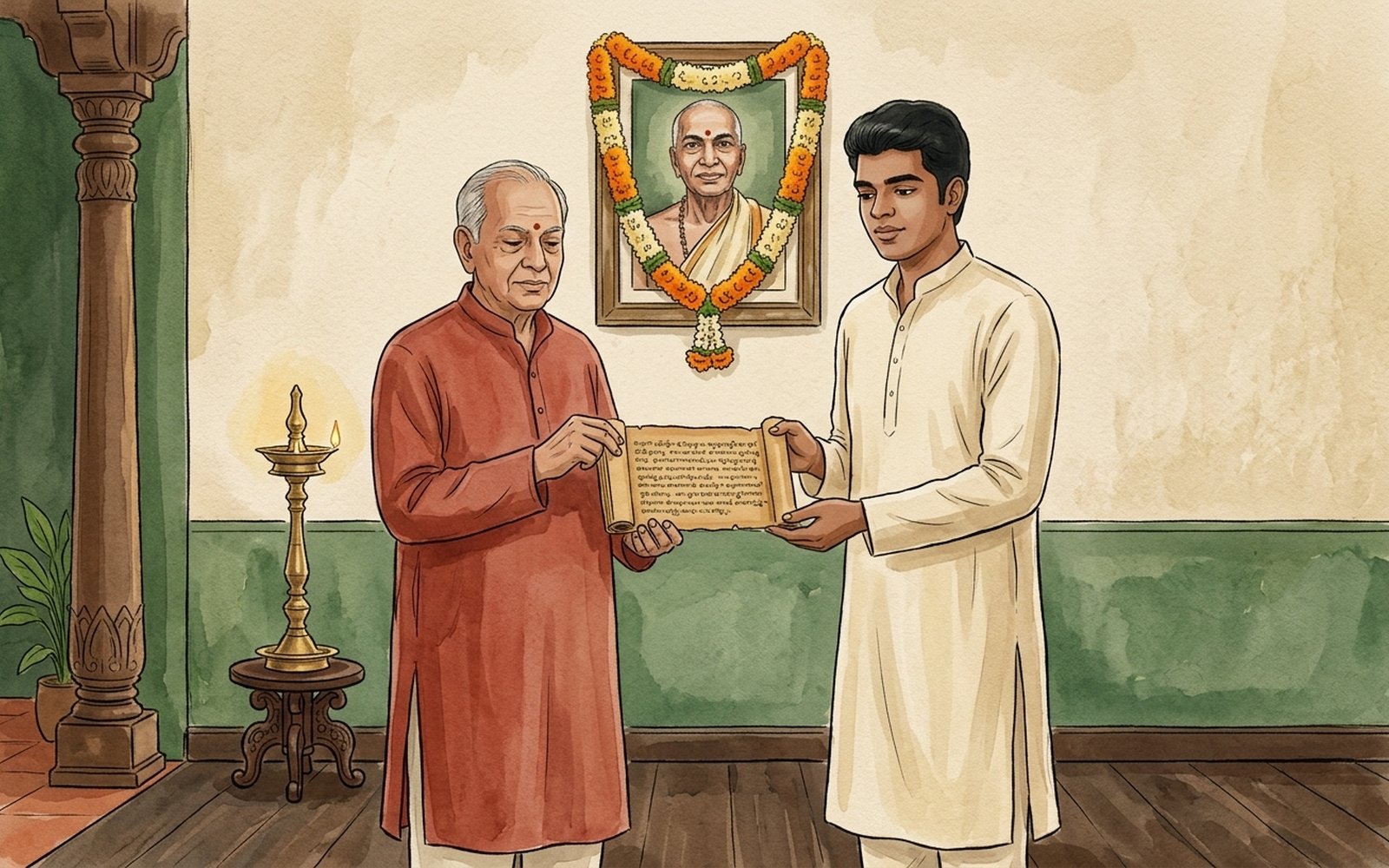
We live in an era where a 200-hour teacher training is considered enough credentials to call yourself a yogi. To put that in perspective: Ramaswami spent 33 years — not weeks, not months — studying with one master, one-on-one, in the traditional Guru-shishya relationship. He wasn't there for asana technique. He was there for everything: anatomy, philosophy, breath, chanting, therapy, philosophy, and the slow inner shifts that come from a decades-long apprenticeship.
Why his lineage is unique
Krishnamacharya taught throughout his long life, and his teaching evolved. Iyengar absorbed his early years — the obsession with alignment and precision. Pattabhi Jois received the dynamic flow that became Ashtanga. Indra Devi carried the practice west. T.K.V. Desikachar refined the therapeutic and individualised elements.
Ramaswami, beginning his study in 1955 and continuing until 1988, is the one student who saw the whole arc — the early years, the middle period, the late refinements. As he himself describes it, he had the rare privilege of watching the master's understanding deepen over decades.
The complete Vinyasa Krama
From Krishnamacharya, Ramaswami inherited the full Vinyasa Krama system — ten sequence groups (Samasthiti, asymmetric seated, symmetric seated, supine, prone, inverted, bow, triangle, on-one-leg, and the special sequences like Surya Namaskar). Inside these groups live more than seven hundred posture variations — each with its own intelligent purpose and adaptation.
It's a far cry from the "sun salutation A and B" we get in most studios.
Sanskrit, chanting, pranayama
Ramaswami was also a Sanskrit scholar — which means he could read Krishnamacharya's source texts in their original language. Yoga is more than poses; it's Yoga Sutras, Hatha Yoga Pradipika, Yoga Rahasya, Bhagavad Gita. Reading them in Sanskrit unlocks layers of nuance lost in translation.
He also received Krishnamacharya's complete pranayama system — including the precise inhale-retention-exhale ratios, the sophisticated Kumbhaka practice, and the integration of Vedic chanting with breath. His book Yoga for the Three Stages of Life is, for many serious practitioners, the most useful single roadmap to a life-long yoga practice.
Why this lineage runs through Weight-Loss Gurukul
My own teacher, Srivatsa Ramaswami, taught me this complete system. Every program at Weight-Loss Gurukul — the 7-day starter, the 90-day Inner Alchemy challenge, the 1-year VIP transform — sits inside this lineage. You're not getting a copy of an Instagram routine. You're getting a faithful transmission, adapted for the modern householder. That's why our results compound: when the source is deep, the practice goes deep with it.